
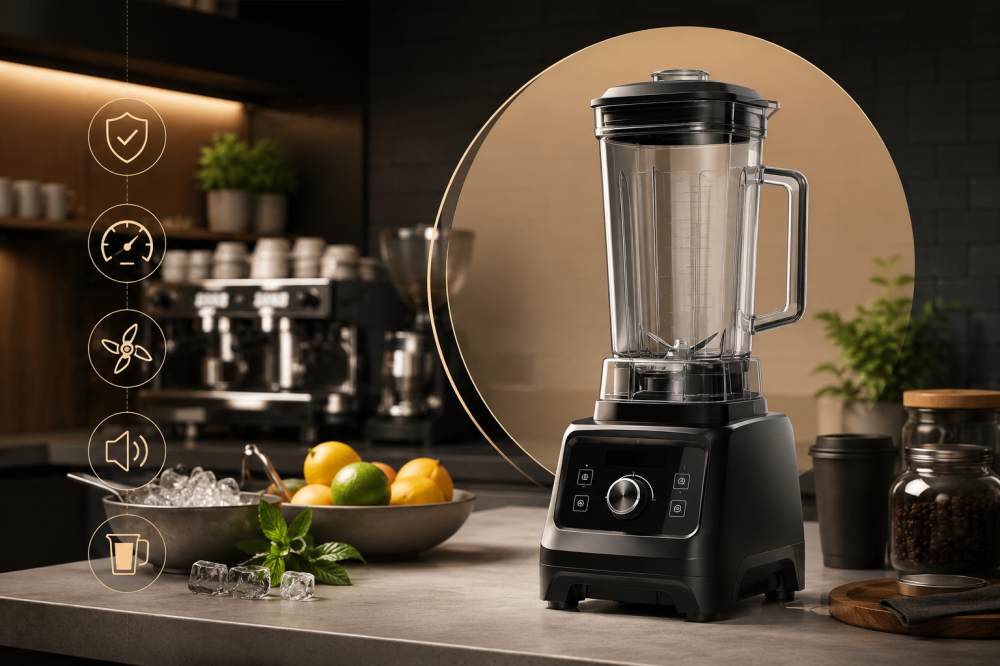
The quality of a commercial blender is not revealed when it succeeds in preparing the first smoothie, but when the twentieth order arrives within one hour, the place is filled with the sounds of equipment, and the barista needs to prepare frappes, mojitos, and milkshakes nonstop.
This is where the true difference becomes apparent between a blender that looks powerful on paper and a professional café blender capable of withstanding the demands of daily use, maintaining consistent beverage consistency, and ensuring timely service. The motor might be powerful, but the container could be unsuitable; the blades might be good, but the machine is difficult to clean between orders; or the performance might be excellent, but the noise detracts from customer comfort.
Therefore, commercial blenders shouldn't be chosen based solely on price or wattage. The right decision requires understanding your drink menu, daily order volume, the nature of the ingredients, the bar's size, and the acceptable noise level within the café.
In this guide, we learn about the most important specifications that should be checked before buying the best commercial mixer for cafes, and how to determine the right device to run your project without paying for features you don't need.
What is the difference between a commercial blender and a home blender?
A home blender may seem suitable during the first few days of running a cafe, especially when the number of orders is limited, but it is not usually designed for frequent operation throughout the day or for crushing large quantities of ice in successive cycles.
Commercial blenders, on the other hand, are designed for professional use in cafes, restaurants, and juice bars. They typically feature a motor capable of withstanding higher pressure, a better ventilation system, a durable container, blades suitable for frozen ingredients, and the option of automatic blending programs.
The importance of a commercial mixer lies in its ability to achieve three basic objectives:
- Preparing drinks quickly.
- Producing a homogeneous texture every time.
- It can withstand frequent use during peak hours.
Therefore, the price of a commercial blender may be higher when purchased, but it helps to reduce breakdowns, downtime, and order delays in the long run.
Determine the blender's intended use before comparing specifications.
There is no single blender that suits all projects. The blender needed for a cafe that serves a limited number of frappe drinks is different from the one used in a shop specializing in smoothies, juices, and frozen drinks.
Before purchasing, determine which drinks the blender will be used to prepare, such as:
- Frappés and iced coffee.
- Fruit smoothie.
- Milkshakes.
- The slushie.
- Frozen drinks.
- Sauces or drink bases.
- Powder mixtures with milk and ice.
- Drinks that contain fruit or dense ingredients.
Also, determine the number of times the machine is operated daily, and the maximum number of consecutive orders during peak hours. This data is more important than looking at the cafe's total sales because the actual pressure on the blender occurs over short, frequent periods.
1. Engine power is not just a number
Motor power is one of the first specifications that cafe owners look for when choosing a commercial blender for juices and cold drinks, but it is not the only factor that determines performance.
The powerful motor helps the machine handle ice, frozen fruit, and dense ingredients, but the final result is also affected by the design of the blades, bowl, transmission system, and software used.
Two devices may have similar power outputs, but one may deliver better results due to its more efficient design. Therefore, you should not rely solely on wattage or horsepower.
Ask the supplier about the type of use it is recommended for, the number of operating cycles the machine can withstand, its suitability for ice crushing, and whether it is designed for continuous commercial use or light use.
It is also necessary to ensure that there is a ventilation system and protection against overheating, because the engine may be subjected to stress when operated repeatedly in a hot or confined environment.
2. The blender's ability to crush ice
Ice is a staple in many summer drinks, but it presents one of the biggest tests for a blender. An unsuitable blender can leave large chunks in the drink, require a longer blending time, or result in a watery consistency due to the ice melting during blending.
When choosing an ice crusher blender, pay attention to:
- Engine power under pressure.
- Blade design.
- The shape of the bowl and its ability to push the ingredients towards the blade.
- Programs designed specifically for frozen drinks.
- Maximum amount of ice per cycle.
Don't just test the blender with water or soft fruit. It's best to try a recipe similar to those found in actual cafes, containing ice, milk, and frappe powder or frozen fruit.
3. Suitable container capacity for cafe orders
Larger capacity doesn't always mean better. Using a large bowl to prepare a single cup can make it difficult for ingredients to reach the blades, while a small bowl may require repeated mixing cycles when preparing multiple orders.
Choose the capacity based on the number of cups prepared in one cycle and the cup sizes available on the menu.
For cafes that prepare each order separately, a medium-sized container may be more practical. Businesses that prepare multiple batches of identical drinks simultaneously may require a larger container.
It is preferable to provide an additional container for the following reasons:
- Work continues while washing the first container.
- Reduce flavor transfer.
- Designate a container for drinks that contain specific ingredients.
- Speed up service during peak hours.
But before buying additional containers, make sure they are compatible with the appliance's base, blades, and lid.
4. The design of the container affects the texture.
The function of the blender jar is not limited to holding ingredients. Its internal shape affects the movement of liquids and ice and their delivery to the blades.
A good design helps create a continuous movement that pulls the ingredients downwards, reducing the need to stop the machine and stir the mixture manually.
Compare the vessels according to the following criteria:
- Easy to pour without splashing.
- The presence of clear measurement scales.
- The container is stable on the base.
- The quality of the handle.
- Tighten the lid.
- The ingredients are easy to add.
- Scratch and odor resistant.
- The possibility of easily purchasing a replacement.
Containers made of professional plastic materials may be lighter and easier to use than glass in a cafe environment, but the quality of the material and its suitability for food use must be ensured.
5. Blades and the quality of the final texture
Increasing the number of blades does not necessarily mean better results. What matters most is the blade's design, material, angle of rotation, and its compatibility with the shape of the container.
A commercial smoothie blender should be able to transform fruits, ice, and liquids into a smooth consistency without leaving large lumps or fibers. Similarly, a frappe blender should maintain a creamy texture rather than producing a separate or watery drink.
When experimenting, observe:
- Smooth texture.
- There are ice cubes.
- The ingredients are homogeneous.
- Time required for preparation.
- The mixture's temperature rose.
- Easy to pour the drink.
Check the method for replacing the blades and their availability among spare parts, especially if the device will be operating intensively on a daily basis.
6. Variable speeds and preset programs
Variable speeds give the barista greater control over the consistency of drinks, while preset programs help to standardize the result and reduce the need to constantly monitor the blender.
Automated programs can be useful in busy cafes; the employee places the ingredients, chooses a frappe or smoothie cycle, and then moves on to another step while the machine is running.
This feature helps to:
- Reducing the difference in results between employees.
- Adjust the mixing time.
- Saving the barista time.
- Reduce excessive mixing.
- Maintain the standard recipe.
But having more apps doesn't necessarily mean a better device. Look for apps that support your actual drink menu, and make sure they are easy for staff to modify or use.
The Pulse button also remains important for quick control over ice breaking or texture finishing.
7. Noise level inside the cafe
The mixer is one of the noisiest pieces of equipment in cafes, and the problem can become apparent when the preparation bar is close to the customer seating area.
If your café relies on a quiet atmosphere or is used for meetings and work, a quiet commercial mixer can be a worthwhile investment. Some models come with soundproof covers or enclosures that help reduce noise during operation.
When assessing noise, do not simply run the device empty; test it while breaking ice, as the sound level varies with solid components.
Also pay attention to how easy it is to lift and clean the insulating cover, and to the overall height of the device when opened, so that it does not collide with the shelves above the counter.
8. Easy cleaning between orders
A blender may have powerful performance, but it will slow down service if cleaning it takes too long. Therefore, ease of cleaning is one of the most important features of the best commercial blender for cafes.
Look for a bowl with easily accessible corners, a lid that can be washed quickly, and a base that doesn't collect liquid in its holes. A self-cleaning cycle or the ability to clean the bowl with water and detergent in a short cycle is also beneficial.
The container should be cleaned after each use, especially when switching between flavors or ingredients that may cause allergies in some customers.
A deeper cleaning should also be carried out at the end of the day, including:
- The bowl and the lid.
- The area surrounding the blades.
- The base of the blender.
- Control panel.
- Soundproof casing.
- Ventilation openings according to company instructions.
9. Endurance and number of operating cycles
The most important question is not: Can the blender make smoothies? But: How many times a day can it do so without performance declining?
Check the commercial device rating, recommended operating type, warranty, and whether the warranty terms cover use within the cafe.
Some devices may be powerful, but they are intended for home use, and therefore their warranty is not valid when used commercially.
Link your decision to the number of drinks you expect:
- Light use: a limited number of drinks per day.
- Average use: Regular operation with rest periods.
- Heavy usage: Continuous orders during peak hours.
Purchasing a device that is below the operating size may lead to malfunctions, while purchasing a high-specification device for a limited project may increase costs without a clear return.
10. Ventilation and thermal protection system
The motor generates heat during operation, and this heat increases when crushing ice or blending thick ingredients. Therefore, the blender needs good airflow around the motor.
The device should be placed in a location where ventilation openings are not blocked and not adjacent to a heat source. The openings should also be cleaned of dust and component debris.
The overload protection feature helps shut down the device if it overheats or the motor is under excessive strain, reducing the risk of damage. However, it is not a substitute for adhering to recommended usage limits and providing the device with suitable operating conditions.
11. Mixer dimensions and bar area
Before purchasing, measure the width, depth, and height of the available space. Don't forget to measure the height when the cover or insulating sleeve is open.
Also determine whether you need a countertop mixer or a model that can be installed within the bar. Built-in models can help reduce height and improve the appearance of your preparation station, but they require prior preparation.
The blender should also be close to the ice area, refrigerator, and sink, so that the barista does not have to travel long distances while fulfilling the order.
12. Electricity and compatibility with the operating site
Check the voltage, frequency, plug type, and the electrical circuit's capacity to power the appliance. Some powerful commercial blenders have different requirements than household appliances.
Avoid using unsuitable connections or sharing a power source with high-consumption devices without consulting a qualified technician.
It is also necessary to ensure that the purchased device is suitable for use in Saudi Arabia, and that spare parts and maintenance centers are available locally.
13. Warranty, Maintenance, and Spare Parts
A low-priced blender may save you money when you buy it, but it becomes expensive if it breaks down and its blades, bowls, or motor parts are unavailable.
Before making a decision, ask about:
- Warranty period.
- What does the warranty cover?
- Warranty valid for commercial use.
- A maintenance center is available.
- Containers, lids, and blades are provided.
- Time required to obtain the replacement part.
- The cost of routine maintenance.
Having a replacement container readily available is of particular importance; because damage to the container should not stop the entire beverage menu from being served.
Common mistakes when buying a commercial blender
One of the most common mistakes is choosing a device based solely on motor power, without testing its texture, noise level, or operating tolerance.
Some business owners make the mistake of buying a home blender to cut costs, only to have to replace it after a short time. Others might choose a large bowl that doesn't suit their recipes or a tall appliance that doesn't fit in their bar space.
Another mistake is:
- Ignore the availability of spare parts.
- Do not buy an extra bowl.
- Failure to check the warranty terms.
- Operating at higher than recommended volumes.
- Place the device in a poorly ventilated area.
- Using non-standard recipes.
- Neglecting daily cleaning.
A successful choice does not depend on buying the most expensive blender, but rather on matching the device's capabilities with the project's needs.
Choose your blender and project equipment from the luxury of coffee
A good commercial blender not only adds a new appliance to your drinks bar, but also helps you serve frappes, smoothies, milkshakes, and frozen drinks quickly and with a consistent consistency.
Coffee Luxury provides integrated solutions for equipping cafes and restaurants in Saudi Arabia, including coffee shop equipment, professional mixers, coffee machines, grinders, barista tools, as well as beverage supplies such as syrups, sauces, frappe powder and smoothie mixes.
You can choose the mixer according to the operating size, type of drinks, and bar space, while providing your project's needs for equipment and raw materials from a specialist in cafe and specialty coffee supplies.
Browse our coffee luxury products, compare available options, and set up a drinks bar that helps your team cope with peak times and deliver a consistent experience for your customers.
Frequently Asked Questions about Commercial Blenders
What is the optimal power for a commercial blender in a cafe?
There is no single power source suitable for all cafes. The choice depends on the type of ingredients and the number of operating cycles. Frozen drinks and ice require a more powerful motor and commercial-grade equipment than simple liquid drinks, while also considering the efficiency of the blades and the container.
Can a household blender be used in a cafe?
It may work with limited use, but it's often not designed for frequent operation or peak-hour pressure. The warranty may also not cover commercial use, so it's advisable to choose a device rated for cafes and restaurants.
What is the appropriate capacity for a blender jar?
Choose the capacity based on cup sizes and the number of drinks you're preparing in one batch. A medium-sized container is often suitable for preparing individual orders, while multiple batches require a larger capacity.
Is a high-wattage blender always better?
Not necessarily. Efficiency depends on the motor, blades, vessel design, transmission, and software. Therefore, the actual result should be tested, and the wattage alone should not be relied upon.
How do I choose a suitable blender for crushing ice?
Find a commercial blender designed for frozen drinks, and test its ability to produce a smooth consistency using the same amount of ice as in your recipes, making sure to use the maximum amount per cycle.
Do I need a soundproof commercial mixer?
Soundproofing becomes important when the bar is close to customers or the café relies on a quiet atmosphere. In enclosed kitchens, however, performance and durability may take precedence over noise reduction.
Are pre-programmed programs necessary?
Not necessary for all projects, but useful in busy cafes; because it standardizes mixing time and consistency, and allows the barista to perform other tasks while the machine is running.
How many blender bowls does a cafe need?
It's advisable to have at least one extra container available to ensure continuous operation during cleaning, minimize flavor transfer, and cope with peak hours. Larger projects may require more depending on the scope of work.
How do I maintain the lifespan of my commercial blender?
Adhere to the recommended quantities, clean the container, base and vents, do not operate the appliance in continuous cycles beyond its instructions, use original spare parts and perform periodic maintenance.
What is the most important thing to check in the blender warranty?
Make sure the warranty covers commercial use, and know the duration of coverage, the parts covered, the location of maintenance, and the availability of containers, blades, and engine parts within Saudi Arabia.